
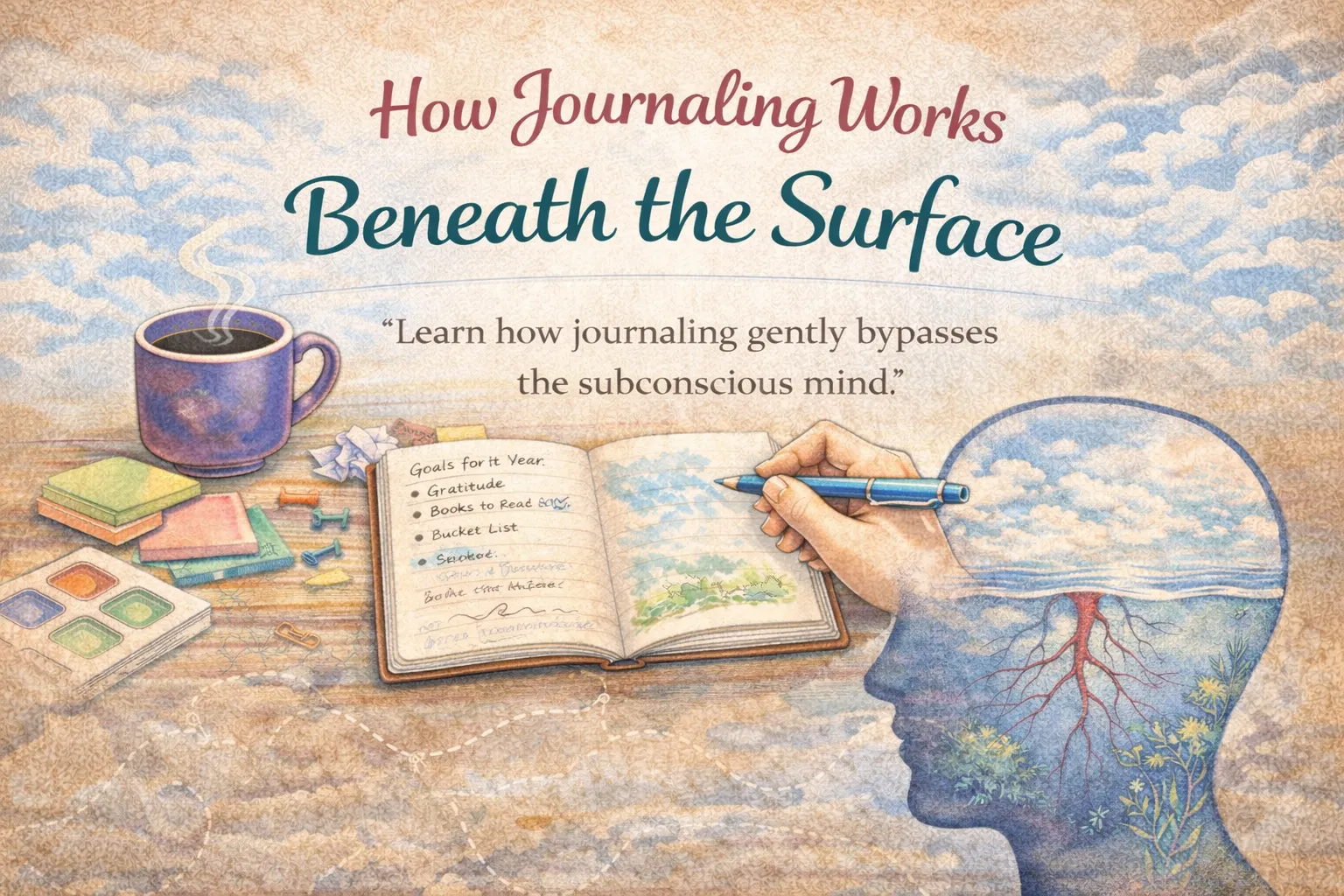
How Journaling Works Beneath the Surface
Your mind operates on more than one level. There’s the conscious mind—the part responsible for thinking, reasoning, planning, and decision-making. And then there’s the subconscious, which quietly runs everything else.
The subconscious does most of the heavy lifting. It regulates breathing, digestion, heartbeat, and all the automatic processes that keep you alive. It’s also in charge of survival responses—pulling your hand away from a hot surface, reacting to danger, and motivating basic needs like eating and resting.
At its core, the subconscious has one job: keep you safe.
The challenge is that it’s very old and very blunt. It doesn’t distinguish well between physical danger and emotional discomfort. To the subconscious, a real threat and a perceived one can feel the same. Failing a test, being judged, feeling embarrassed, or risking rejection can register as danger just as strongly as something physically harmful.
So it does what it knows how to do—it protects you.
That protection often shows up as hesitation, fear, avoidance, or self-doubt. The subconscious builds invisible barriers around things that feel risky, even if those things could help you grow. These barriers are different for everyone, shaped by past experiences, beliefs, and learned fears.
To understand what’s behind those barriers, they have to be gently bypassed.
There are only a few ways this tends to happen. Intense situations can override fear completely. Long-term therapy can slowly bring patterns to the surface. And writing—surprisingly—can do something similar.
When you write freely, without overthinking or censoring yourself, you often slip past the mind’s protective filters. Something about the physical act of writing allows thoughts, memories, and realizations to emerge before the subconscious has time to shut them down.
That’s why journaling can lead to unexpected insights. You might uncover connections you hadn’t consciously made—old experiences influencing present fears, patterns you didn’t realize you were repeating, or truths you’d been avoiding.
It takes practice and patience, but over time, journaling becomes a quiet way to access what’s already there. Not by force, but by permission.
And once those hidden patterns are visible, real change becomes possible.